Albert Butz: For only a dollar.
June 7, 2026
Somebody had to go down to the basement.
That was the reality of heating a home in Minneapolis in the 1880s. The furnace burned coal, and the only way to control it was a damper, a metal flap that let air feed the fire or starve it. Too cold upstairs? Someone walked down and opened the damper. Too hot? Down again to close it. In a Minnesota January, this wasn't a quaint chore. It was a job performed at two in the morning, in the dark, every night of the winter, in every house that could afford a furnace at all.
We tend to remember the inventors who made heat. Almost nobody remembers the man who made heat behave.
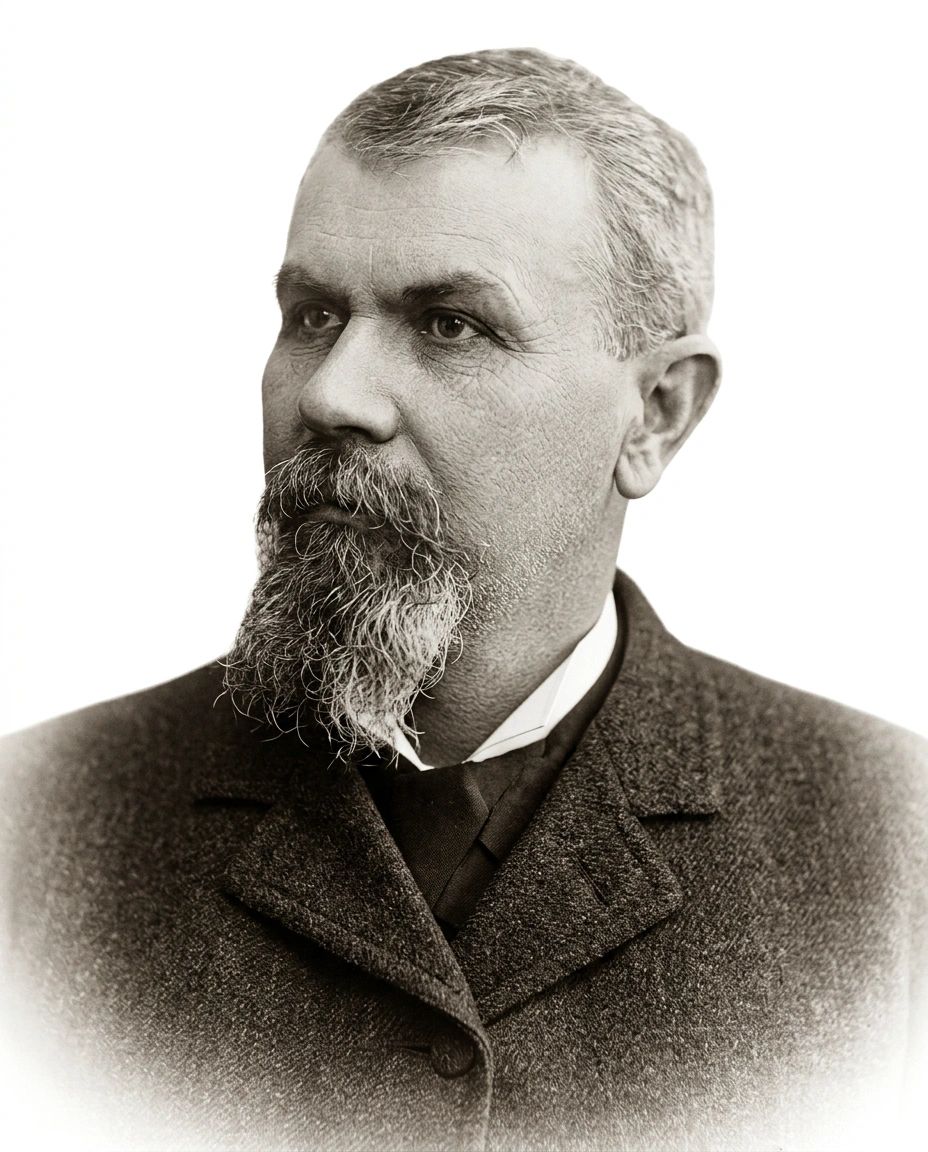
Albert Butz was born in Switzerland in 1849 and immigrated to the United States as a boy. He enlisted in the Union Army at sixteen, caught the last six months of the Civil War without seeing combat, and eventually surfaced in St. Paul in 1881. He was, by every account, a tinkerer more than a businessman. His first venture tells you that much: in 1884 he co-founded the Butz and Mendenhall Hand Grenade Fire Extinguisher Company, which planned to sell glass grenades filled with fire-suppressing liquid. There's no record they ever sold one.
But Butz was circling something. His grenade company wanted to deal with fire after it escaped. His next idea made sure it never needed to.
In 1885 he worked out a device that would later earn the least romantic nickname in the history of home comfort: the damper flapper. The premise was dull, the way most important things are. A thermostat upstairs watched the room temperature. When the room cooled past a set point, a circuit closed, and a small battery-powered motor in the basement pulled the furnace damper open. Air fed the coal. The fire burned hotter. When the room warmed up, the circuit opened and the damper dropped shut.
Three components. A thermostat, a battery, a motor.
What Butz actually invented wasn't a gadget. It was an architecture. He separated the sensing from the doing. The brain upstairs, the muscle downstairs, a wire in between. That split, sensor to actuator, is the grammar of every control system built since. Your building automation system speaks it. So does the CarbinX unit we bolt onto a boiler room wall. A thermostat deciding when a damper moves is the same sentence as a controller deciding when a pump ramps. We've been conjugating Butz's verb for 140 years.
The patent for his "thermo-electric damper-regulator and alarm" was granted on May 4, 1886, a few days after he incorporated the Butz Thermo-Electric Regulator Company in Minneapolis. And here the story takes the turn that I find more instructive than the invention itself.
Butz couldn't sell it.
There's no documented record of a single sale. By 1888 he had abandoned the business entirely and moved to Chicago, leaving his patents with his law firm. Nobody knows exactly why. The lawyers renamed the company, renamed it again, and in 1892 the stockholders sold the entire patent portfolio to a young businessman named W.R. Sweatt.
For one dollar.
Sit with that for a second. The foundational patents of what would become one of the largest controls companies on earth changed hands for a single dollar, because the people holding them couldn't figure out what they were worth. Sweatt could. He spent decades building the business, first as the Electric Heat Regulator Company, then as the Minneapolis Heat Regulator Company, selling reliability one furnace at a time. In 1927 the company merged with Honeywell Heating Specialties of Wabash, Indiana, becoming Minneapolis-Honeywell. By 1964 it was simply Honeywell.
Butz, meanwhile, kept inventing. Thermostatic valves, temperature regulators for steam buildings, a liquid vending apparatus. Eleven more patents before he died in 1905. He never stopped making things. He just never built the company. I wrote a while back about two kinds of CEOs: the ones who start with a market and the ones who start with a mission. Butz is the cautionary footnote to that post: the maker who never found his Sweatt. The idea was right. The architecture was right. And it still took a second man, a dollar, and forty years of unglamorous selling to turn it into the default temperature of the modern world.
Which brings me to the part that should make us uncomfortable today.
Let me be clear about something first. When I see a Nest or an Ecobee on a wall, I don't roll my eyes. I get excited. The HVAC industry is not known for widespread innovation. I've written about that before. So when something comes along that makes people genuinely enthusiastic about a thermostat, of all things, that's a win. Small wins like these are exactly what this industry needs. They are the damper flapper's true heirs: dull premise, real friction removed, and people actually want them on the wall.
The residential side, in other words, is getting its Butz moment. It's the commercial side that worries me.
Walk into the boiler room of a commercial building, the rooms where I've spent over two decades, and you'll find Butz's revolution sitting half-finished. In North America we treat these rooms as dungeons. The building goes up, everything gleams, and for the first few years the mechanical room looks like the renderings. Give it five or ten. The lights get a little dimmer. The dust gets a little thicker. Broken equipment gets left behind by trades who figured it didn't matter, because nobody who signs cheques ever comes down here. Building automation systems installed and never commissioned. Schedules overridden years ago by a tenant who was cold one weekend, never reset. Heating and cooling quietly fighting each other in the same air handler, like two people steering one car.
The research here is blunt. When Lawrence Berkeley National Laboratory analyzed commissioning projects across hundreds of commercial buildings, they documented over 10,000 energy-related faults and found that simply commissioning existing buildings (making the controls do what they were always supposed to do) delivered median whole-building energy savings of 16 percent, with a payback of about a year. Not a new boiler. Not a heat pump. Not a breakthrough. A person with a laptop and a wrench, finishing the job the building forgot it started.
Sixteen percent. For tuning.
That is some of the cheapest carbon abatement available anywhere, and it goes begging in dungeon rooms on every block, because tuning controls has the same problem the damper flapper had in 1886. It works. It's valuable. And it's boring. Nobody hosts a panel about commissioning. There's no ribbon cutting for a recalibrated sensor. The work wears overalls, and we keep walking past it on our way to the announcement.
Butz's device didn't make heat. It made heat pay attention. A hundred and forty years later, the buildings have changed, the fuels are changing, and the lesson hasn't moved an inch: the fire is rarely the problem. The control of the fire is the problem.
I'll admit the Butz story sits close to home for me, and not in a comfortable way. He had the right idea and the right architecture, and he still walked away, his patents sold off for a dollar by people who couldn't see what they held. I think about that more than I'd like. Because I'm chasing my own dull, architectural idea: a catalytic converter for buildings. A box in the basement that deals with what combustion leaves behind, the way Butz's box dealt with what combustion demanded. I am fully prepared to fail at this. Most people who try things like this do. But I will not give up on the idea, because the technology is coming either way, and I intend to be the one who delivers it, alongside my team and the supporters and investors who carried us this far. Butz's mistake wasn't the damper flapper. It was leaving before the world caught up.
So here's what I keep wondering. Somewhere right now there's an idea changing hands for a dollar because the people holding it can't see what it's worth. Something dull, something architectural, something that just reduces friction. What's our generation's damper flapper? I think I know what mine is. It's sitting in a boiler room, wearing overalls, waiting for the rest of us to come downstairs.