AI Building operators and the future of heating
October 11, 2025
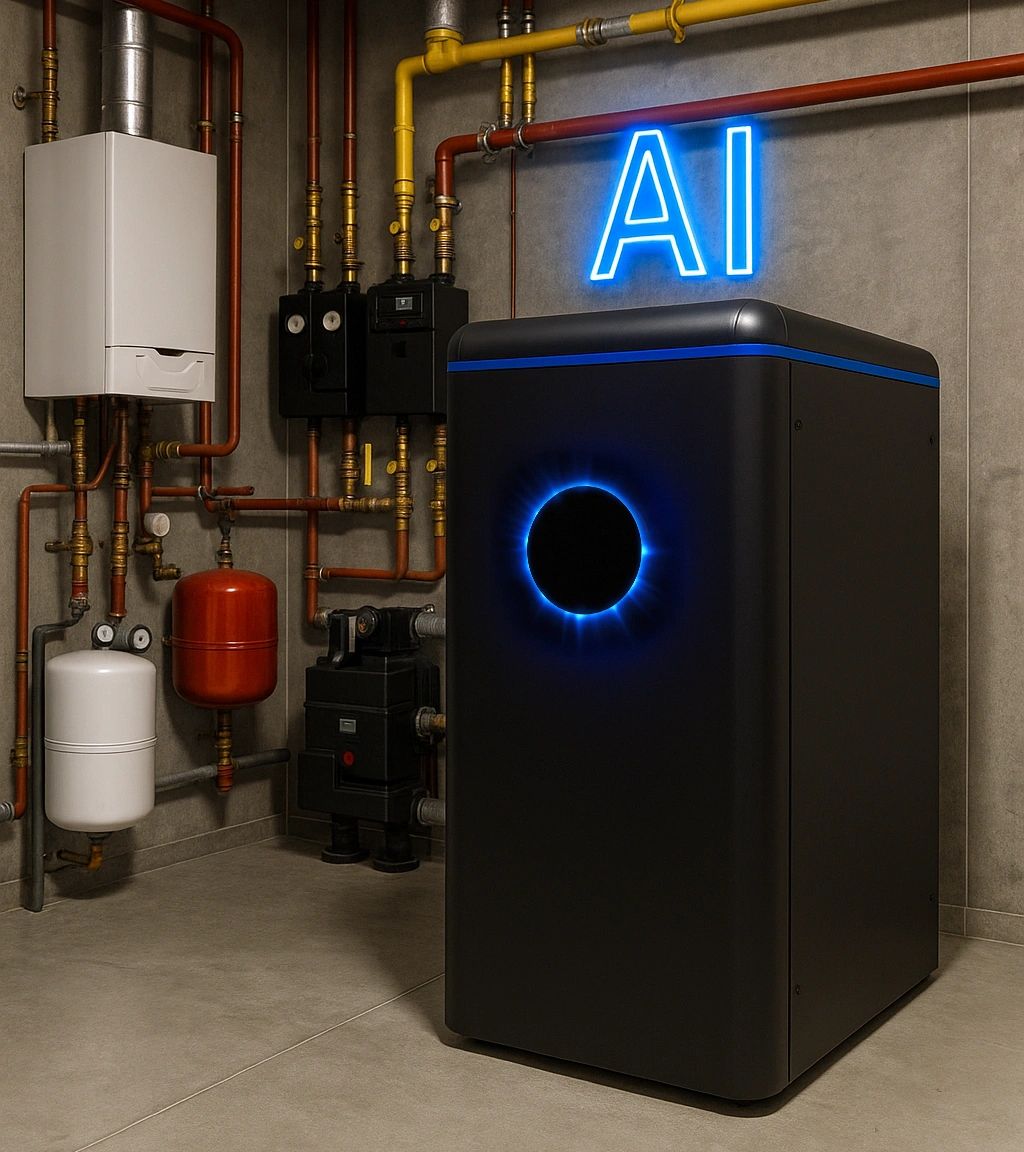
The hum of the mechanical room has always been a kind of music to me. Piping harmonics, pumps murmur, and the faint click of relays keep the rhythm. For generations, this is the world of technicians, with calloused hands and eyes trained to spot problems before the instruments could. Now comes the machine learning algorithms.
Artificial intelligence has conquered almost every polished space imaginable, from art galleries to trading floors and customer service chat boxes. But down here, in our domain, where the pipes sweat and the air smells faintly of combustion, it’s just beginning.
Imagine a technician walking into that room, Starbucks in hand, the familiar symphony of noise filling their ears. Somewhere in the background, a digital apprentice listens too. Sensors whisper pressure readings, heat signatures, and combustion ratios. The AI watches silently, parsing years of operation logs and learning the pulse of the building. It doesn’t guess or assume; it calculates. And one day it speaks: “The hot surface ignitor on boiler number 2 is likely going to fail in the next 36 hours. Would you like me to contact the local supplier and order the part?”
It’s not replacing the technician. It’s joining them. The human still knows the language of sound, the slight grinding noise of a recirc pump that’s seen better days, the burn marks on the side of the boiler indicating faulty refractory. The machine knows the patterns no human could hold in their head. Together, they start to make sense of what’s really happening inside those steel arteries.
But the partnership isn’t perfect. AI doesn’t understand that a hotel’s boiler behaves differently on a cold morning than on a Sunday evening after checkout (yet). It doesn’t grasp that sometimes you override a setting not because it’s efficient, but because it’s humane. For now, the technician still has the moral compass; the machine has the map.
In a previous post, we touched on Geoffrey Hinton’s advice that people should consider becoming plumbers as artificial intelligence reshapes the workforce. That comment made waves because it sounded refreshingly grounded, but it also missed a key point. AI doesn’t just threaten the cubicle class; it could hollow out the trades too. The future plumber or gas fitter might not need to think the way their predecessors did. With diagnostic support, automated part ordering, and instant access to virtual training libraries, the role risks shifting from problem-solving to process-following. It’s efficient on paper, but it risks eroding the craftsmanship that once defined the trade. When a technician no longer needs to reason through a fault but merely confirms an AI’s prediction, the human part of the profession begins to fade.
This shift isn’t theoretical; it’s already in motion. Major companies like Siemens, Honeywell, and Johnson Controls have launched AI-driven platforms that learn from the buildings they control. Siemens’ Building X uses predictive modelling to adjust operations before faults occur. Honeywell Forge uses machine learning to balance heating and cooling loads based on real-time carbon data. Johnson Controls’ OpenBlue creates self-learning digital twins that refine efficiency and maintenance cycles over time. Each system pushes buildings toward self-awareness.
In the near future, mechanical rooms won’t look like they do today. The smell of burnt dust on a startup cycle and the clank of expanding steel will fade, replaced by quieter, cleaner, self-balancing systems. The rooms will be smarter, yes, but also strangely sterile. Somewhere in that space, a person will still stand with a wrench, staring at a tablet that already knows what they’re about to do. Maybe they’ll miss the old chaos. Perhaps they won’t.
Artificial intelligence won’t replace the technician. It’ll make mistakes too, hopefully fewer of them.