Behavioural Science and the ‘Thermostat Problem’
December 13, 2025
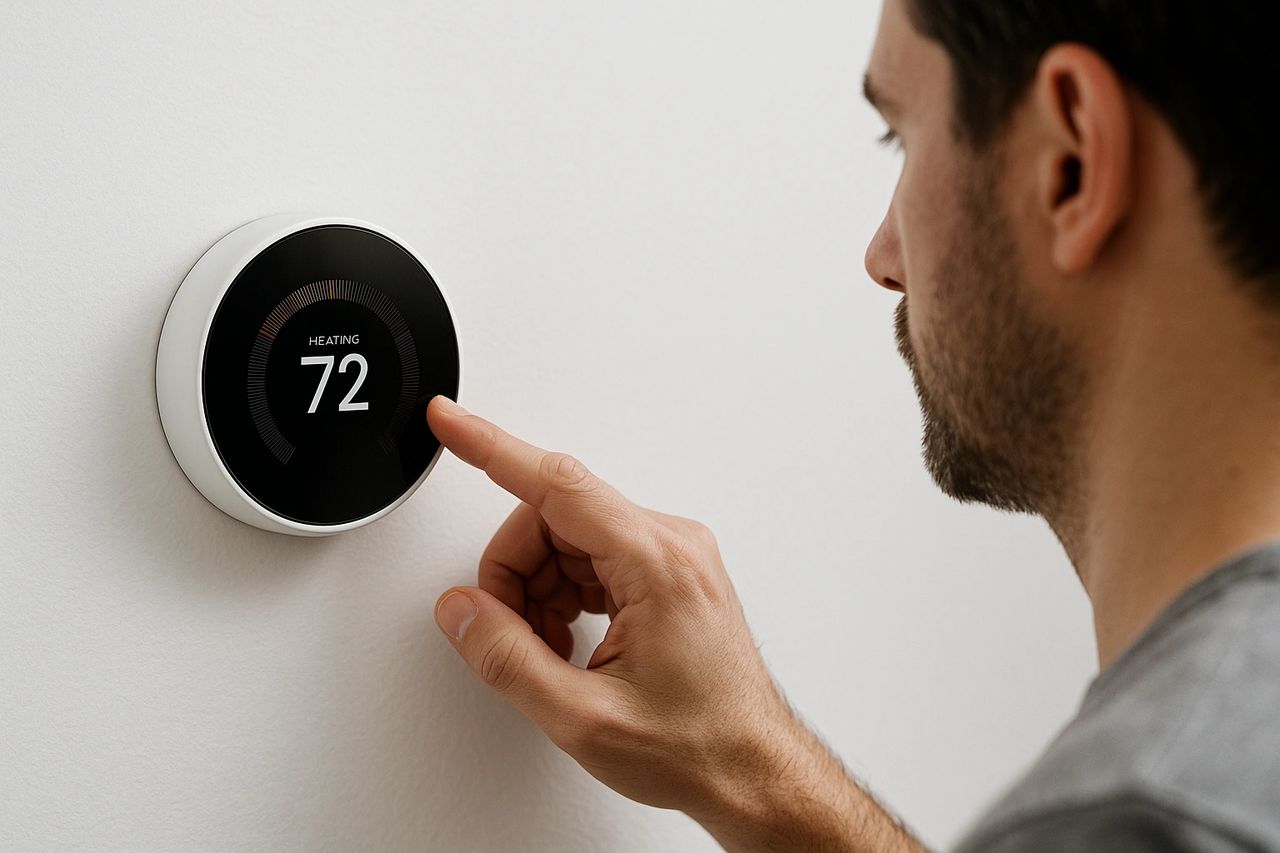
Heating has never really been about hardware. That’s the convenient story we lean on because metal, valves, and circuit boards behave predictably. People don’t. You can engineer a boiler to within a degree of perfection, but you can’t engineer someone’s relationship with a thermostat. Case in point: my wife sets our house to 17°C in the winter, and if I adjust it, I get the Look, that piercing glance down the hallway that says I’ve committed a quiet act of treason. Nothing is wrong with the equipment.
The chaos is entirely human.
This is the thermostat problem, a behavioural failure disguised as a mechanical one. For thousands of years, heat technology moved forward while human behaviour lagged behind. The Romans gave us hypocausts that warmed entire floors; Victorians made cast-iron radiators into mass-market comfort; modern engineers squeeze efficiency from fuel with surgical precision. Today, we’ve stepped into heat recovery, carbon capture, predictive controls, and systems that self-optimize even when no one is paying attention.
Yet even the smartest hardware ends up hobbled when the humans using it behave irrationally.
Behavioural science keeps showing the same patterns. People override schedules even when the schedule is right. They crank the thermostats higher, thinking it heats faster, a bit like hammering the crosswalk button because impatience feels like action. They crack windows while the heating system runs because the room feels stuffy, throwing energy out the window in exchange for a quick hit of “fresh air.” A 2018 study from the University of California’s Center for the Built Environment found that nearly 40 percent of thermostat adjustments in commercial buildings were made not for temperature, but because occupants “felt the system wasn’t responding,” even when it was performing exactly as intended. Similar findings show up elsewhere. Research from Cornell University’s Human Factors Lab showed that people often adjust thermostats to signal discomfort rather than to reach a measurable temperature change, using the control as a kind of communication tool. Meanwhile, a study from the University of Toronto found that office workers routinely misinterpret thermostat feedback entirely, treating the device as a suggestion box rather than an input to an automated control loop. These patterns span geography, climate, and building type, so they stop looking like anecdotes and start looking like a dependable behavioural signature.
At the same time, the relationship between people and thermostats has shifted again in the era of remote access. Systems from Honeywell, Ecobee, and others no longer require anyone to physically “visit” the wall-mounted controller. Temperature, schedules, setback strategies, and even occupancy patterns can be viewed and adjusted from a phone, a laptop, or a building dashboard. Behavioural researchers at Carleton University and MIT have noted that this shift adds a new psychological wrinkle: when the thermostat goes digital, people treat it less like a household object and more like a negotiation with an algorithm. Ecobee’s public data analyses show that users interact more often with smart thermostats precisely because the interface feels conversational instead of mechanical. Yet even with this added insight, the core behaviours remain the same: comfort overrides logic, and the desire for control never really goes away.
None of this comes from ignorance or malice. It comes from the very human urge for control. We want to feel like we’re influencing comfort, even when the system is capable of doing it better on its own.
That’s the real frontier in heating and carbon tech. The limiting factor isn’t combustion chemistry or heat-exchanger geometry. It’s behaviour. If we want modern systems to reach their potential, we have to design around what people reliably do, not what we hope they might do.
A behaviourally aware heating philosophy accepts that comfort decisions happen instantly and emotionally, that “set it and forget it”, a phrase coined by inventor Ron Popeil, has never existed outside a marketing brochure, and that people trust systems that show their work. They respond to defaults more than instructions, and the interface they touch often shapes outcomes more than the engineering behind it. The real promise lies in systems that quietly reduce the need for human intervention, shrink the behavioural surface area of building operations, and translate the hidden mechanics of heat into something intuitive instead of mysterious. When systems teach rather than obscure, people make better decisions without feeling like they’ve been pushed out of the loop.
The thermostat problem won’t vanish. Humans stay wonderfully unpredictable and sometimes self-defeating. And honestly, that’s probably for the best, because the alternative is a world where two androids argue over whether 21°C feels warmer than 20°C. Until that dystopia shows up, good design, thoughtful defaults, and systems that teach instead of obscure are enough to keep us moving toward meaningful change.
Heating evolves. Behaviour evolves slowly. That gap is where the real work and the real opportunity live.