Soft vs Hard: A common problem in tech
December 30, 2025
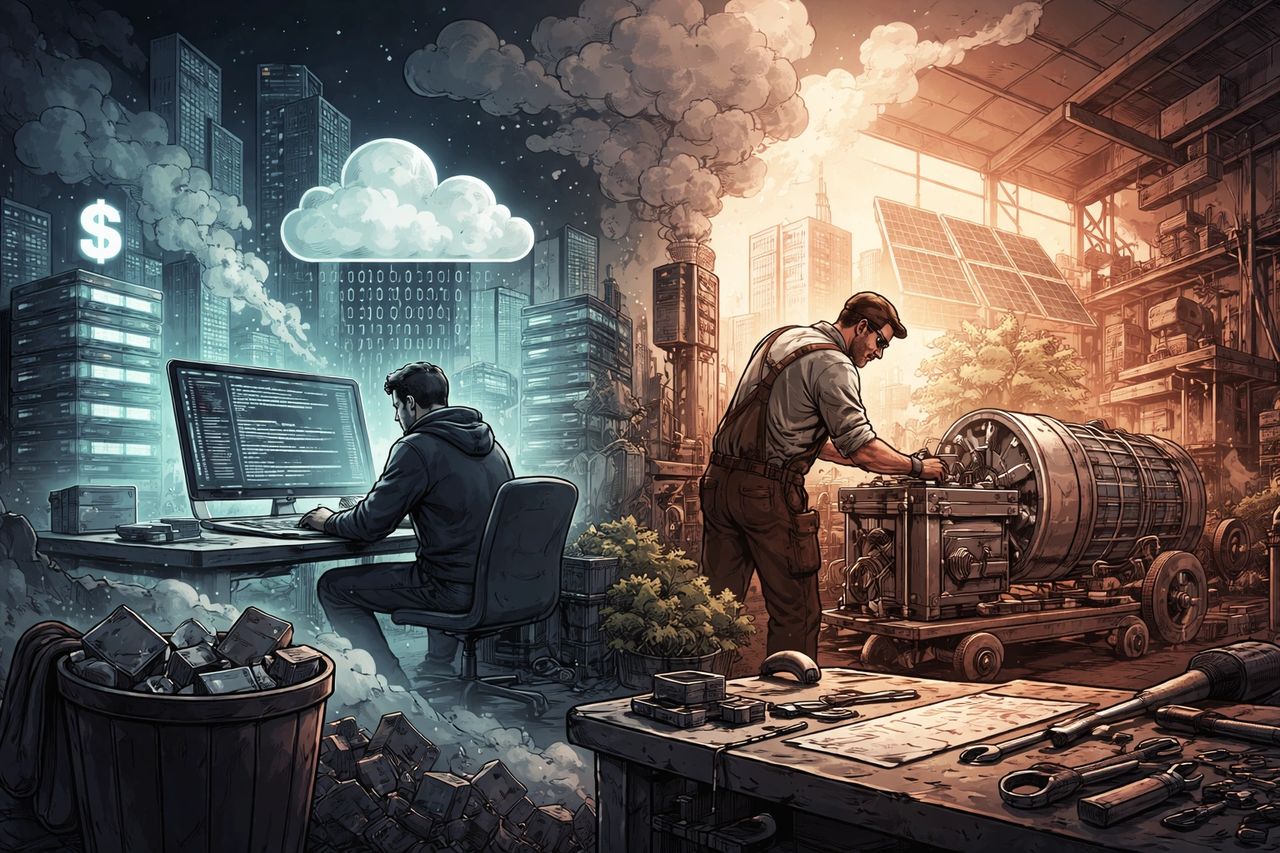
I’ve developed a fairly strong aversion to YASC or Yet Another Software Company. Not because software is useless or trivial, but because it has become the default answer to problems that are not, at their core, software problems. Energy, carbon reduction, and the built environment are physical systems. They obey physics, thermodynamics, materials science, and time. And yet, we keep showing up with dashboards, apps, and AI layers, as if rearranging pixels can meaningfully change how heat moves through steel or how combustion chemistry works inside a boiler.
There are a staggering number of software companies in the world. Exact figures are slippery, but estimates routinely land in the tens of millions when you include SaaS, mobile apps, internal tools, and venture-backed startups. Software is cheap to start, quick to iterate, and forgiving of mistakes. You can deploy broken software and patch it tomorrow. You can pivot without scrapping inventory. You can fail quietly. Hardware offers none of these luxuries. When you get it wrong, you get it completely wrong. In metal, concrete, supply chains, certifications, and sometimes safety margins are measured in lives rather than user sessions.
My bias toward building physical things didn’t come from a pitch deck or a startup blog post. It came from watching my father and his father work with their hands, fix things that were supposed to be broken, and treat tools as extensions of thought rather than disposable accessories. Making something tangible carries a different kind of accountability. If it fails, you can’t hide behind a wireframe or flow chart. It either works or it doesn’t. That imprint stays with you. Once you’ve built something that has to survive heat, pressure, corrosion, or years of neglect in a mechanical room, the idea of shipping vaporware feels rather dishonest.
The decline of the maker mindset worries me more than most people are willing to admit.
There’s an irony here that rarely gets quantified. Writing software feels carbon-light, but it isn’t free. A typical mid-sized software product might involve a handful of developers working for a year or two. Factor in laptops, cloud compute for development and testing, CI pipelines, and early production hosting, and you are already looking at tens to low hundreds of tonnes of CO₂ before a single user logs in. Add modern AI tooling, large model training, or GPU-heavy inference, and that footprint grows quickly. Data centres are efficient, but efficiency is not the same as zero, and the energy use is continuous.
By contrast, developing a piece of hardware front-loads its carbon cost. Prototypes require material extraction, machining, casting, electronics, transport, and testing. A physical product might carry a few tonnes of embodied carbon before it ever ships, sometimes more for complex systems. The difference is what happens next. Hardware that displaces fuel, recovers waste heat, or improves efficiency can repay its carbon debt in months or years, not decades. Software rarely does that on its own. It measures, optimizes, or reports, but it almost never directly changes the physics it observes. We live in an era optimized for instant gratification and disposability. Products are sealed, proprietary, and designed to be replaced rather than understood. The skills required to make, repair, or improve physical systems are slowly being treated as niche hobbies instead of foundational capabilities. Software fits neatly into this cultural drift. It’s abstract, weightless, and detached from material consequence. Hardware forces confrontation with limits, trade-offs, and responsibility. Not everyone enjoys that confrontation.
There’s also an uncomfortable truth that doesn’t get discussed enough. A software developer never truly owns their product. Software is always downstream of someone else’s hardware. Servers, phones, operating systems, networks, GPUs, cloud providers. Every layer introduces dependency and loss of control. You can design the cleanest user experience imaginable and still watch it collapse under a firmware update, a browser change, or a cloud outage you don’t control. Hardware builders have constraints, but they also have sovereignty. If you own the physical system, you own the experience end to end. That matters when reliability is not a feature but a requirement.
In cleantech and energy, the imbalance becomes even more pronounced. There are far more software startups than hardware ones because software offers the illusion of impact without the burden of infrastructure. Measuring emissions is easier than reducing them. Optimizing a process on paper is easier than changing the equipment that actually burns fuel. Software can promise scale without ever touching a wrench. Hardware has to earn scale, one installation, one certification, one skeptical customer at a time.
Investors understand this, which is precisely why they avoid hardware. Hardware demands capital before validation, patience before revenue, and competence across disciplines that don’t fit neatly into spreadsheets. Cash gets locked up in inventory. Timelines slip because suppliers fail, regulators move slowly, or physics refuses to cooperate. From a venture perspective, this looks like unnecessary suffering when software offers faster exits and cleaner narratives. Risk becomes something to avoid rather than something to price appropriately.
But energy transition and carbon reduction don’t happen in spreadsheets or slide decks. They happen in boilers, furnaces, compressors, buildings, and industrial processes that have been quietly doing their jobs for decades. Pretending otherwise is convenient, not effective. Software has a role, but it is a supporting actor, not the protagonist. When we confuse abstraction for progress, we end up with a lot of clever code orbiting the same unchanged physical reality.
I don’t dislike software. I dislike the way it has become a reflex. YASC isn’t a criticism of developers. It’s a warning about a culture that keeps choosing the easiest tool instead of the right one. If we’re serious about energy and carbon, we need to rebuild respect for the people who make things, fix things, and are willing to wrestle with the physical world as it actually is. That work is slower, messier, and harder to explain in a pitch. It’s also the only kind that moves the needle.