The Long Game: Changing How We Think About Carbon Capture
November 3, 2025
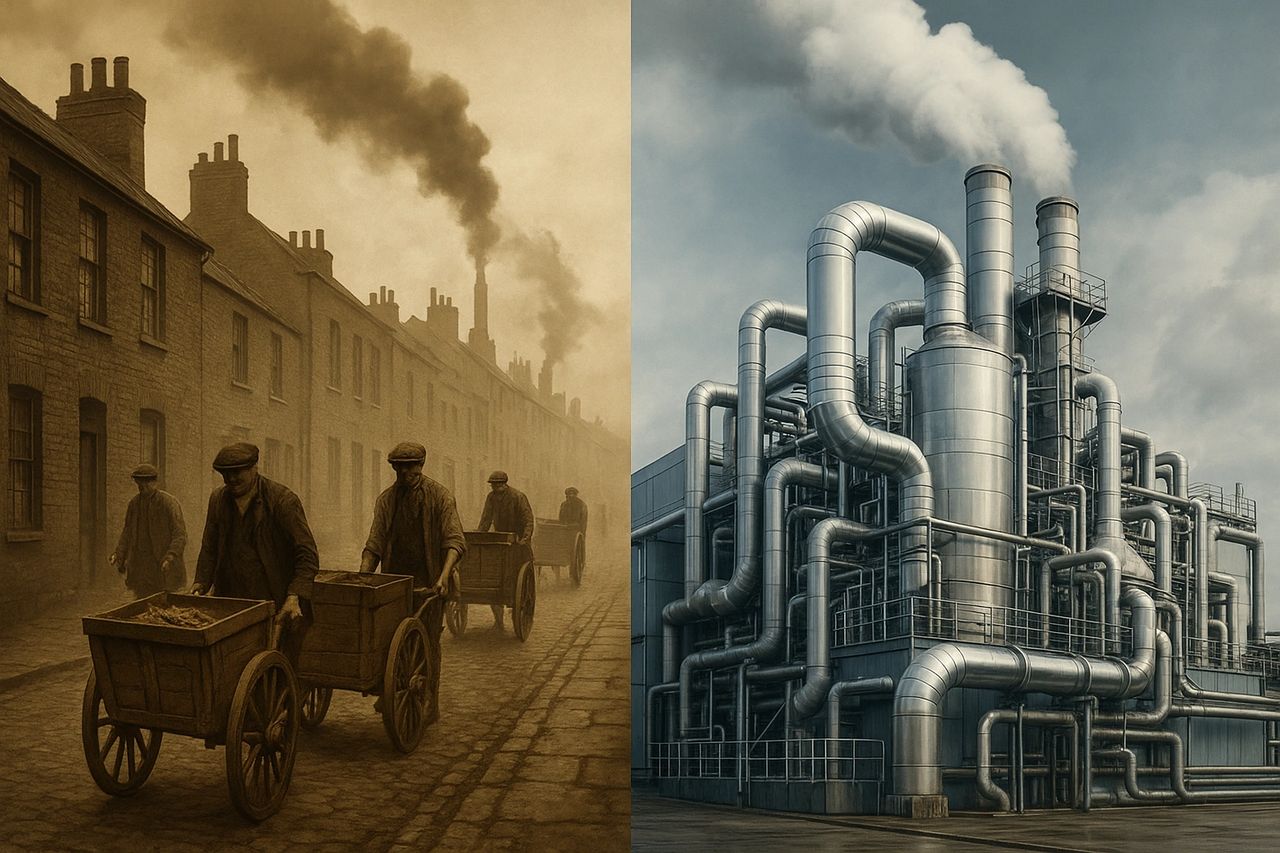
Let’s get this out of the way early: natural gas isn’t disappearing. Not tomorrow, not next week, not in five years, and probably not entirely ever. Maybe it’ll morph into hydrogen someday, maybe biogas will take a bigger share, but for now, and for decades to come, natural gas is going to remain part of the energy mix. That’s not cynicism; that’s pattern recognition.
History has already shown us what happens when we build grand narratives around “endings” that never quite arrive. Coal was expected to fade from modern economies by the 1980s. It didn’t. In fact, it’s still being mined, transported, and burned today, just more efficiently, with more regulation, and in smaller markets. Cities didn’t stop making garbage either. We just learned to manage it better. When the first waste collection systems appeared in Victorian London, people thought they were temporary, that once industrial society “cleaned up its act,” we’d need fewer bins, fewer dumps, fewer workers hauling refuse through the streets. But human behaviour didn’t change. Consumption grew, and so did the waste. The systems evolved with it.
Natural gas is following a similar trajectory. It’s been lighting and heating homes since the early 19th century, first with coal-derived town gas, later with natural gas once pipelines made it widely available. It survived the rise of electricity, the oil boom, the nuclear dream, and now the renewable revolution. Every time we think it’s on the verge of extinction, the market adapts, because it’s reliable, scalable, and already built into everything from district heating to fertilizer production. Pretending it’s about to vanish is like declaring the end of paper after email arrives. Spoiler alert: we still print things.
Now, none of that means we shouldn’t be pushing for electrification. We absolutely should. The world needs cleaner energy, but it also needs more energy. The idea that we can simply unplug fossil fuels overnight without consequences is a comforting fantasy that collapses under the weight of reality.
I remember talking to an investor a couple of years back who said, “What happens when natural gas is turned off in a few years?” It didn’t matter what I explained, efficiency curves, transition timelines, or infrastructure inertia, the belief was immovable. To some, the future is binary: fossil fuels off, renewables on. But transitions have never worked that way. They take generations, not election cycles.
And here’s the part people rarely talk about: innovation suffers when expectations are unrealistic. If you convince investors and policymakers that natural gas will be gone by 2030, they’ll stop funding practical solutions that could reduce emissions today. They’ll chase silver bullets instead. But progress doesn’t come from fantasy; it comes from iteration.
So where does carbon capture fit in all this? Exactly where waste management was a century ago. When early sanitation engineers proposed collecting urban waste, critics asked, “Why pay to move garbage when we can just bury it in the yard?” That was the 1800s version of, “What’s the ROI on carbon capture?” The answer then is the same now: because the cost of doing nothing is far greater, even if it takes a generation to see it.
We eventually learned that managing waste wasn’t a luxury; it was a necessity. Entire industries grew around it: collection, treatment, recycling, repurposing. People pay for these services not because they profit from them, but because civilization depends on them.
Carbon capture is no different. It’s a service, not a gadget. A logistics and storage industry that exists because we’ve chosen to burn carbon-based fuels and still want a livable planet. Somebody has to handle the byproduct. Someone has to “take out the trash.” Whether that means direct air capture, flue-gas scrubbing, or mineralization, it’s still a form of cleanup.
The only real question is: who pays for it? When a business hires a waste hauler, nobody demands an ROI spreadsheet. They pay because the alternative, letting garbage pile up, is unacceptable. The only reason it feels different with carbon is that the mess takes longer to show up. It doesn’t reek in the alleyway; it warms the atmosphere.
If we can adjust our mindset to see carbon the way we see garbage, as an inevitable byproduct that must be handled, the economics start to make sense. The ROI isn’t in immediate payback; it’s in continued existence.
Waste management took centuries to normalize. Carbon management will take the same patience, the same pragmatism, and the same willingness to build systems that don’t make the front page but quietly keep the world functioning.
The faster we accept that, the sooner we can get to work on cleaning up the mess, without pretending the source will disappear overnight.
A Brief History of Waste as a Service
Before organized sanitation, cities were toxic. In 1858, London’s “Great Stink”, a summer so foul the Thames literally reeked through the windows of Parliament, finally forced lawmakers to act. Joseph Bazalgette, an engineer with more persistence than glamour, built an underground sewer network that transformed public health and urban living. It wasn’t profitable. It wasn’t glamorous. But it saved lives and made modern civilization possible.
New York followed a similar path. The Department of Street Cleaning, established in the 1890s, faced ridicule for charging citizens to collect garbage. Newspapers mocked the idea that refuse needed “management.” Yet within a generation, sanitation became one of the city’s largest municipal services, invisible but essential.
That same invisible infrastructure mindset is where carbon capture belongs. It won’t have a red-carpet debut. It’ll be a slow, gritty evolution, trucks, tanks, scrubbers, monitoring systems, all working quietly in the background while the rest of the world moves on to its next innovation headline.
The story of waste management isn’t about perfection; it’s about persistence. And if history is any guide, carbon capture will follow the same arc, resisted at first, then relied upon completely. When catalytic converters were first proposed in the 1970s, automakers fought them bitterly. They claimed the technology was too expensive, too fragile, and unnecessary. But smog in Los Angeles got so bad that public outrage forced lawmakers to act. The U.S. Clean Air Act of 1970 made emission controls mandatory, and within a decade, the same companies that resisted the change were marketing their cars as “cleaner” and “smarter.” The transition wasn’t driven by sudden virtue; it was regulation meeting necessity. Once people could literally see the difference in the air, there was no going back.