The Things We Throw Away
January 3, 2026
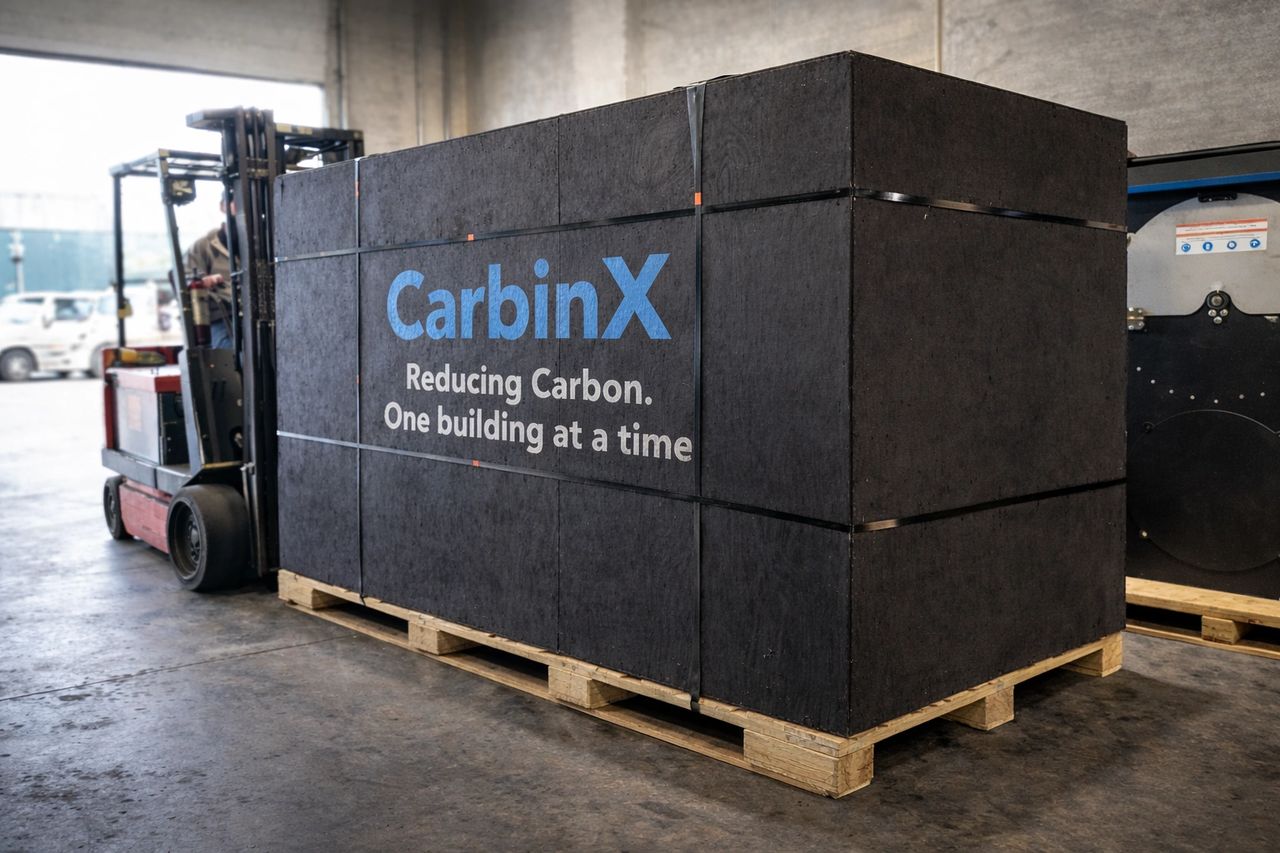
There’s a particular feeling you get when equipment arrives on site. Not excitement. It’s the pause before you sign for it, when the truck door rolls up, and you watch the crate either slide down on a power tailgate or get swung onto the ground by a knuckle boom. Anyone who’s spent time around mechanical rooms or construction trailers knows the look right away. Splintered lumber. Boards that don’t quite match. Nails bent over instead of pulled. A structure that suggests the fabricator was less concerned with elegance than with not running out of wood. Boilers are the worst offenders. They often arrive looking like they were packed in a hurry from whatever scrap was leaning against the shop wall. I don’t fault the impulse. Wood gets reused. Something that might have gone to waste gets another job. Still, it’s hard not to feel how much it cheapens whatever’s inside.
When we first started shipping our own carbon capture systems, we went hard in the opposite direction. We hired actual carpenters to build crates, not crate builders pretending to be carpenters. Shout out to the crew at Carriers Crating in Calgary. These things were beautiful. Overbuilt, square, easy to unpack. It was a deliberate choice, and not a quiet one. We wanted the uncrating to feel intentional, closer to opening high-end electronics than tearing into industrial freight. There’s psychology in that moment. It signals care. It tells the installer, the owner, and the inspector that someone slowed down. In an industry that often treats packaging as an afterthought, it felt like a small way of showing respect for the work.
We even painted them.
That took longer than it should have to register as a problem. Once you coat lumber, it stops being benign. It can’t be chipped and dumped into garden mulch. It doesn’t get reused in the casual ways untreated wood does. A cosmetic decision, made mostly for feeling, quietly shut down the material’s future. The crate did its job once and then became something everyone was relieved to get rid of. That realization stuck with me more than the rule itself. We hadn’t set out to create waste. We just hadn’t thought past the delivery.
There’s no honest way to pretend that shipping heavy equipment is neutral. The lumber alone represents time. Trees that took decades to grow, harvested, milled, cut, screwed together, used once, and discarded. Add fasteners, strapping, wraps, and the fuel burned getting everything where it needs to go, and the crate starts to feel less like a container and more like a system. One that almost never gets the same scrutiny as the machine it protects.
What’s easy to miss is how fast these small decisions scale. We’re very good at engineering sophistication into objects whose main design requirement is that no one ever has to think about them again. Globally, packaging is one of the shortest-lived uses of material we have. Hundreds of millions of tonnes of plastic get discarded every year, and packaging accounts for a big share of it. Material engineered, moulded, shipped, and optimized for a single pass through the supply chain. Only a sliver ever makes it back into meaningful reuse. The rest is buried, burned, or scattered, carrying the emissions from extraction, processing, and disposal along with it. Even paper and cardboard, often treated as the virtuous option, move at staggering volumes, with more than half of global production going into packaging that lives for weeks, sometimes days.
We stopped painting the crates. That part was easy. The harder part has been sitting with the rest of it. Even untreated, even reused, a disposable crate is still disposable. It still assumes that the cleanest outcome is throwing something away efficiently. Once you start paying attention to that assumption, it shows up in places you didn’t expect, and then you can’t quite unsee it.
Lately, we’ve been looking at alternatives that feel less final. There’s an early-stage company in Switzerland building collapsible crates meant to travel with equipment to the site and then come back again. It was started by people who’d spent enough time around industrial logistics to be dissatisfied with the default answers. Traditional wooden crates and pallets work, in the narrowest sense, but they’re expensive for what they deliver, wasteful by design, and basically impossible to track once they leave the yard. Everything about them assumes a single trip and a quiet disappearance.
What they’re building is modular and reusable, closer to infrastructure than packaging. It can be configured around equipment of very different sizes and weights, taken apart after delivery, and put back into circulation instead of heading for a landfill or burn pile. The ambition goes further than reuse. There’s an effort to make the crate legible. To know where it is, how often it’s been used, how hard a life it’s had. Packaging that remembers its own history, instead of pretending it never mattered.
In theory, one crate replaces many. In practice, there are still plenty of unanswered questions. Cost. Durability. The real carbon math once you account for return shipping and storage. What happens when something gets damaged, or lost, or stuck on the wrong continent because a project slipped by six months? None of that is resolved, especially not for a small team trying to ship heavy equipment without drama.
What keeps me interested isn’t that this is a solved problem. It’s that it refuses to let the question close. It pushes back on the convenience of pretending that packaging becomes someone else’s responsibility once the unit is installed and humming along. It treats the crate as part of the system, not something you quietly drag behind a dumpster at the edge of the yard.
We’re still shipping heavy equipment. We’re still using materials that took real time and energy to produce. Some waste doesn’t go away just because you notice it. But I’ve found I’m no longer comfortable pretending not to see it. I hate throwing things out when I know they didn’t need to be single-use. I hate throwing things out when I know they didn’t need to be single-use. We’re still figuring out what to do with that.