Where Japan’s Energy Transition Actually Begins
January 6, 2026
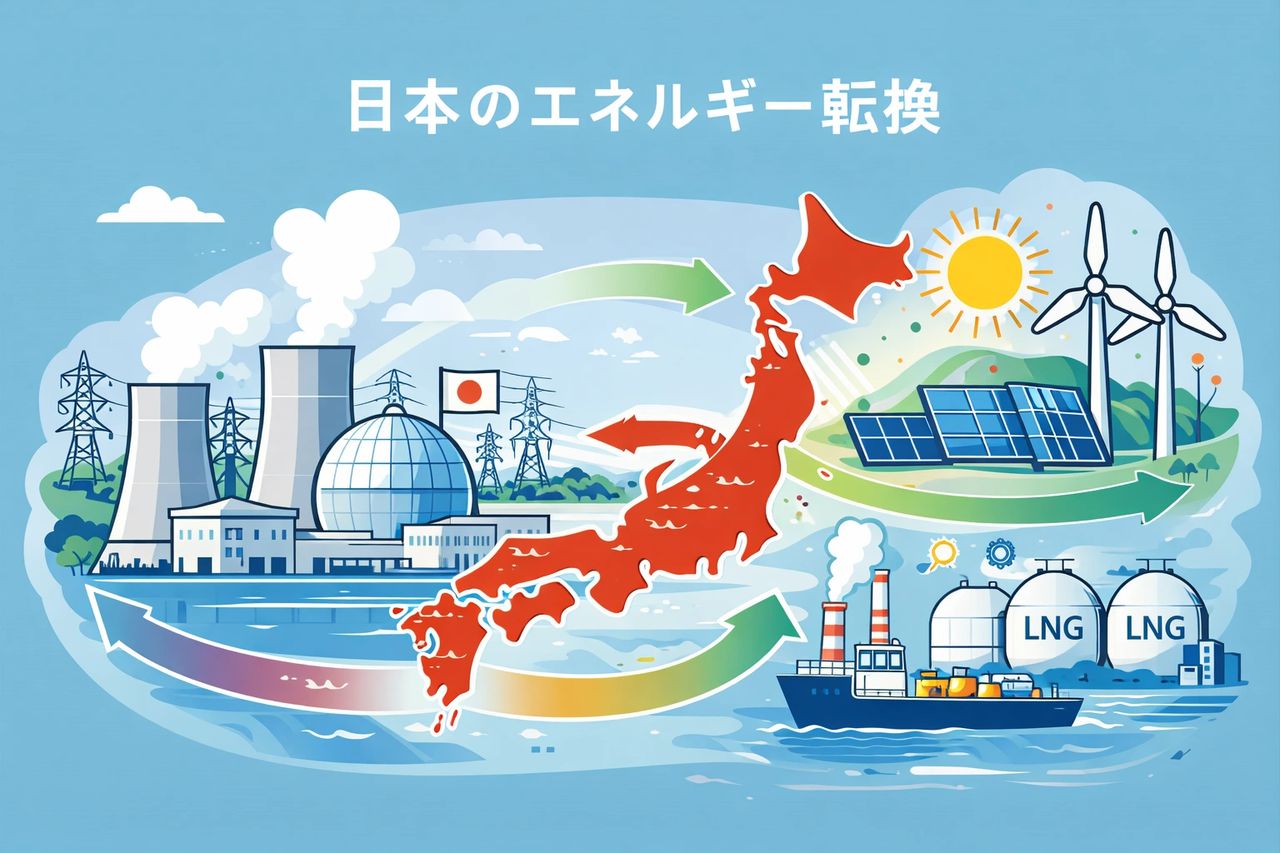
Japan has been adjusting its energy policy for many years, largely through incremental shifts rather than sharp declarations. That caution is understandable. Energy decisions here carry long memories, and institutional language reflects that, even when the history is left implicit. In 2025, however, the government made a set of choices that were more clearly articulated than in previous cycles. The Strategic Energy Plan outlined a 2040 power mix with nuclear restored to roughly a fifth of supply, renewables scaling to forty to fifty percent, and thermal generation continuing to play a role, though under tighter constraints and with clearer expectations around risk management. This is not a rejection of existing energy systems or operators. It reads instead as an attempt to balance realism, security, and transition, building on the capabilities already in place while reducing long-term exposure. The numerical targets themselves are straightforward. Around twenty percent nuclear by 2040, forty to fifty percent renewables, and the remainder that acknowledges present needs without treating them as permanent.
From the outside, this read like just another installment in the global energy transition storyline, easy to slot into familiar camps of praise or disappointment depending on prior beliefs. International coverage tended to do exactly that. One prominent UK outlet described the plan as both overdue and insufficient in the same article, which is a fairly standard move in that genre. What that framing misses is that in Japan, very little of the real work happens at the level of declarations. The substance sits inside existing assets and organizations that cannot simply abandon what they have built. Utilities and trading houses still have to keep systems running, manage fuel risk, and answer the phone when customers expect heat on a cold morning. Policy sets direction, but execution lives in places that are operationally constrained and publicly accountable.
Japan remains heavily dependent on imported fuels. The power system still reflects regional separation, legacy utility boundaries, and past build decisions that no policy document can quickly undo. Much of the industrial economy runs on natural gas rather than electrons, and that energy has to be delivered every day, independent of policy cycles or press conferences. Steel production does not pause for revised targets. Steam demand does not respond to long-term scenarios. Read in that context, the 2025 plan comes across less as a dramatic pivot and more as a recognition of where decarbonization narratives tend to lose precision: when they encounter balance sheets, workforce arrangements, and physical equipment that is still operating safely and economically, and therefore cannot simply be wished away.
That acknowledgment is familiar if you have spent time working with companies like Tokyo Gas. In those conversations, what you notice is not resistance or denial, but a steady, practical interest in alternatives that can operate alongside what already exists. The question is rarely how to eliminate emissions outright. It is how to take responsibility for the emissions their infrastructure is already producing, and how to do that without destabilizing customers who depend on them for something as basic as heat on a winter morning. That constraint never goes away. It just sits there, quietly shaping every other discussion.
There have been no dramatic confrontations between old energy and new, largely because the groundwork had already been laid. What followed instead was a long, deliberate exploration of what might actually be possible. Years, not months, spent building shared understanding. A quiet recognition that relationships mattered at least as much as performance curves, and sometimes more. The technical challenges came later, after it was clear that everyone involved was serious about the work itself, not just how it would appear in a slide deck.
That is where our work entered the picture. We were working on ways to handle flue gas as a physical stream, on-site, rather than as an accounting problem. The interest was not only in reducing emissions, but in what could be done with what was captured. Producing usable carbonates mattered because they were tangible outputs that could be handled, stored, sold, or set aside if they didn’t pencil out. This was not about credits or offsets. It was about taking responsibility for what comes out of the stack, in real time, with operators present.
Momentum built slowly, which in Japan is not a failure mode so much as a sign that something is being tested seriously. In that context, Okaya & Co. became an important bridge, not because they pushed for speed, but because they brought continuity. A company that has operated for centuries tends to be selective about where it invests attention. Okaya helped translate between expectations on both sides, supported logistics and early business development, and explored what a shared market could look like over time. Their involvement signalled that this was not a side experiment. It was an effort to understand how new tools might enter a commercial ecosystem that already functioned, even if imperfectly.
The constraints were real, and they were not always technical. One of the more revealing challenges turned out to be zoning. In Japan, a commercial property cannot be designated to produce a commodity, which meant that installing carbon capture equipment explicitly for the purpose of producing carbonates was not permissible. That distinction mattered more than anyone expected. Progress depended not on contesting the regulation, but on working within its intent, framing the system as emissions filtration with a secondary material outcome. The regulation has not changed. The conversations continue, quietly, in rooms without windows.
Carbon itself was discussed in multiple registers at once. As something to be reduced. As a cost to be managed. As a liability already sitting on the balance sheet. As a future option that might or might not acquire value later. Sometimes all of those showed up in the same meeting, without anyone pushing too hard to reconcile them. There was no single agreed-upon language. It reflected a system still working out what carbon actually was in practice, and who would be expected to hold it once the accounting stopped being theoretical.
Japan is not presenting the transition as fast or elegant. In practice, it looks more like working carefully with what already exists, improving systems piece by piece, sometimes awkwardly, without pretending otherwise. Speed, novelty, and confident claims carry less weight than consistency. Credibility shows up slowly, through alignment with existing systems and a willingness to stay present when something doesn’t work as expected.
Japan’s recent energy choices and our experience working alongside Tokyo Gas and Okaya unfolded in similar ways. Not as a revolution or a clean break, but as a series of negotiated adjustments made under pressure. Most of that work happened far from policy documents, inside mechanical rooms and long meetings, where heat still had to be made and systems were not allowed to fail.
The author is grateful to colleagues at Tokyo Gas for their careful review and insights on Japan’s energy and regulatory context. The views expressed here remain solely those of the author.