Why Breweries Are Rethinking Heat and Carbon
December 27, 2025
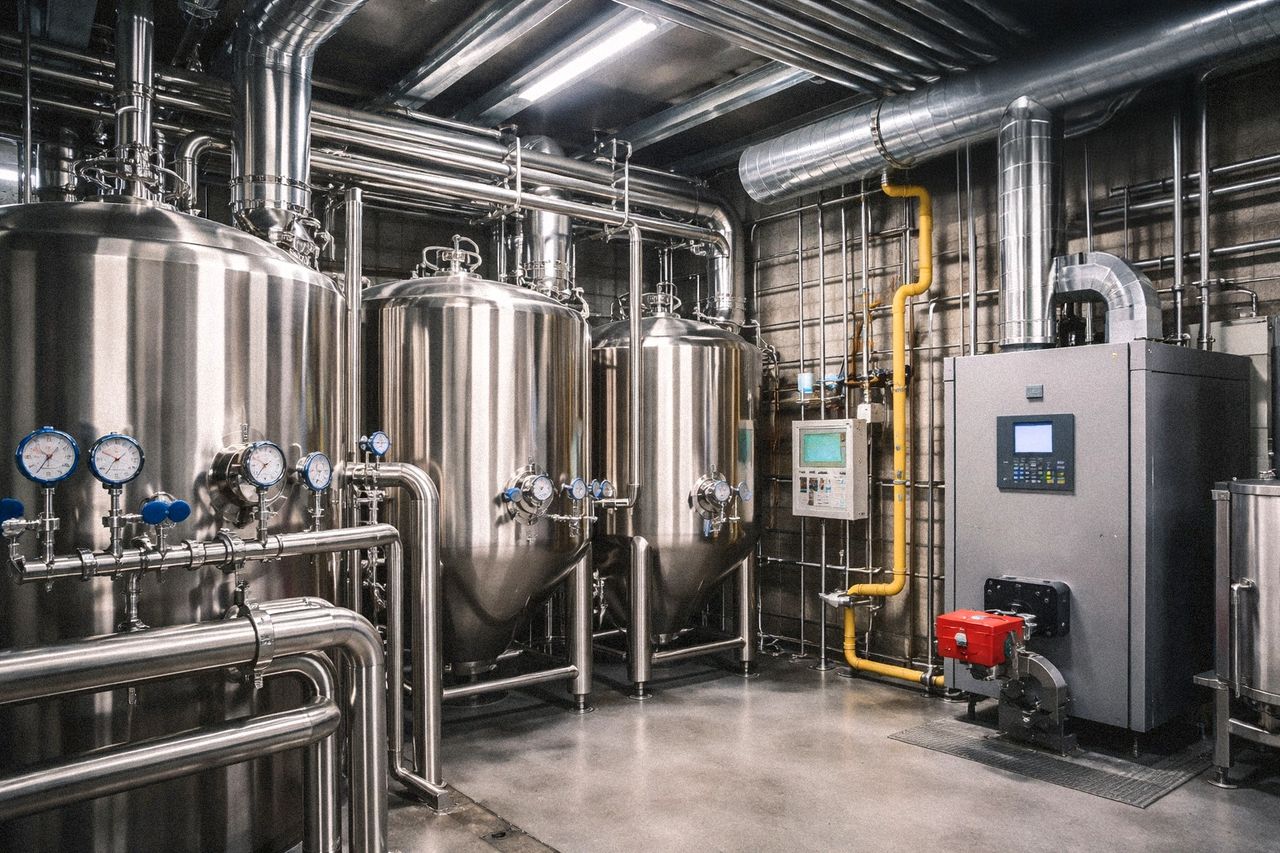
Beer is marketed as simple. Grain, water, yeast, and time. An intoxicant, yes, but one we’ve spent centuries insisting is wholesome, artisanal, and somehow exempt from industrial reality. It’s a pastoral loop we’ve been comfortable repeating for a very long time. That story works right up until you step into the back of a brewery and notice how much of the operation depends on fire, heat, and things leaving the building through a stack.
Breweries, for all their romance, are heat factories. Boilers run constantly. Hot water is absolute and non-negotiable. Fermentation vents CO₂ because chemistry doesn’t care about intent or branding. Exhaust stacks do what exhaust stacks have always done: move heat and carbon out of the building and into the air, quietly and without ceremony. For decades, nobody questioned that flow. It wasn’t elegant, but it was normal.
For a long time, that was acceptable. Energy was cheap enough that losses could be ignored. Emissions were diffuse, regulated loosely, and treated as someone else’s problem. Inefficiency lived in the background, tolerated because it didn’t show up loudly enough on a balance sheet to demand attention.
That background has crept forward. Fuel costs rose. Utilities became less passive. Regulators sharpened their pencils. What used to be invisible inefficiency started showing up as an operating expense that refused to flatten out, no matter how much effort went into tuning the brewhouse itself. Better burners helped. Better insulation helped. Smarter controls helped. None of it made the bills stop climbing.
Around that same time, utilities began paying closer attention to breweries, not as cultural institutions, but as energy users. In Southern California, a gas utility rolled out a program aimed directly at brewery infrastructure. Not branding. Not packaging. Boilers, exhaust, and energy recovery. The dull, unavoidable systems that actually dictate how much fuel gets burned every day. Utilities don’t do this out of curiosity. They do it when a sector is large enough to matter and inefficient enough to justify intervention. Breweries checked both boxes.
What matters here isn’t the rebate amounts or the clever acronym attached to the program. It’s the assumption underneath it. Exhaust is no longer being treated as a necessary loss. Heat leaving a flue is being treated as something measurable, improvable, and in some cases recoverable. Even carbon, long handled as an externality, is being pulled back into the conversation as something that might be captured instead of automatically vented. Once utilities start asking questions about stacks and flues, the old mental model starts to wobble.
What’s changing now is a willingness to question the structure itself. The assumption is shifting from “this is unavoidable” to “this is poorly designed.” Capture emissions where they occur. Reuse what would otherwise be wasted. Reduce the load before talking about offsets, credits, or future grid promises. This isn’t ideology. It’s a response to constraint, visible in utility programs, pilot projects, and quiet experiments reshaping mechanical rooms.
Large brewers are moving in this direction because they’re under pressure to reduce direct emissions and report progress publicly. Smaller brewers are exploring it for a simpler reason. Charm matters. Experience matters. None of it offsets rising energy costs that quietly eat away at already thin margins. Universities and startups are testing compact systems tied directly to exhaust streams because the vent-and-forget logic collapses the moment someone actually runs the numbers. This isn’t being driven by aspiration. It’s being driven by spreadsheets and fuel bills.
There’s a version of sustainability that lives in labels, packaging, and storytelling. That version exists for consumers. Operators live somewhere else entirely. They care about fit, uptime, maintenance, and whether savings show up on a gas bill instead of in a report. When heat and carbon management start meeting those criteria, they stop being philosophical conversations and start becoming operational decisions.
Breweries are a strange but revealing place for this shift. They’re culturally visible, mechanically intense, and energy dependent in ways that are hard to disguise. If managing heat and carbon on-site can make sense there, it won’t stay confined to beer. It will show up anywhere hot water runs all day, anywhere boilers fire continuously, and anywhere exhaust is still treated as an inevitability rather than a design flaw.
The comforting story is that sustainability is about values and choice. In breweries, it’s about constraint. Fixed brew schedules. Boilers that can’t be turned off. Hot water demand that doesn’t politely scale down. Rising fuel costs, physical limits in mechanical rooms, and fewer places to hide inefficiency once the easy upgrades are gone.
That shift, once it starts, tends not to reverse.